Royal Jewel Match: Casual Gaming Breakdown
The difficulty curve in this format is not gradual. It arrives in three distinct steps, and each one introduces a mechanic rather than simply asking for more of the same.
Stage bands and what changes between them
Three bands, three different games. Knowing which one you are in tells you what to practise, and stops you attributing a wall at stage sixty to bad luck.
| Stage range | Mechanics introduced | Difficulty | What to practise |
|---|---|---|---|
| Levels 1–50 | Three-tile matching, row-clearing boosters | Beginner | Playing low on the board by habit |
| Levels 51–150 | Locked tiles, double-layered ice | Intermediate | Clearing obstacles before objectives |
| Levels 151 and up | Irregular board outlines, tight move limits | Advanced | Counting the move budget before move one |
A reading of how the format is paced, not a figure published by any developer. Individual titles set their band boundaries differently, and a stage inside a band can still be far harder than its neighbours.
Going band by band
The first fifty stages exist to teach the swap and to make you comfortable. Almost nothing can be lost here, which is exactly why they are worth playing deliberately: this is where you build the habit of scanning the bottom third of the board before the top, at no cost. Players who spend this band matching whatever catches the eye arrive at stage sixty with a habit that then has to be unlearned.
The middle band introduces obstacles, and with them the first genuine decision the game asks: clear the objective, or clear the thing standing in front of it. Locked tiles absorb the first match made on them, so every locked cell quietly adds a move to the stage; double-layered ice needs two hits on the same square. Neither is difficult on its own. What makes this band hard is that the move allowance is still generous enough to let you ignore them until it is too late.
The third band changes the board rather than the pieces. Outlines become irregular — narrow columns, isolated pockets, corners fed by a single column — and the move limit tightens to the point where two wasted turns lose the stage. Nothing new is being tested except planning, which is why players who reached this band by reflex stall here and players who reached it by reading the board do not.
Where a stage feels impossible, the useful question is not “what booster do I need” but “which cell on this board is hardest to reach”. On an advanced stage the answer is nearly always the whole problem.
Spatial foresight, and what it actually means
The phrase gets used constantly in writing about this genre and almost never explained. It is a concrete, learnable skill and it has two parts.
The first is knowing what will fall. Refill is vertical: pieces enter at the top of a column and drop straight down, and nothing moves sideways unless you swap it. So after any clear, you can say with certainty which cells will change and which will not. The cells that will not change are where your problems live, because no cascade will ever solve them for you.
The second is knowing what that leaves. A match is not just the pieces it removes; it is the arrangement it creates one row down. Skilled play on these boards looks slow because the player is checking the second thing rather than the first — not “does this match” but “what sits here afterwards”.
Both are trainable without any purchase. Take a stage you have already cleared, and before each move say out loud which two columns will change. Being wrong is the useful part; after a dozen boards you stop being wrong.
Short sessions, and why the format suits them
A stage in this genre runs roughly ninety seconds to three minutes, and that constraint explains most of the design. No long tutorial, nothing that cannot be skipped, no penalty for closing the app mid-board, progress saved between stages rather than during them. A game in this format that makes you sit through something before playing is working against its own shape.
It also explains why the board waits. Nothing on screen moves until you move, which means the thinking time is free and the pressure is entirely self-generated. Players who feel rushed on a match-three board are rushing themselves, and on the advanced band that is the single most expensive habit there is.
For a commute the practical measure is stages per charge rather than minutes played. A quietly built puzzle game draws very little between moves; one that heats the phone is usually running an animated background or holding a video pre-loaded. Trying it once on your own device tells you more than any published figure, including any on this page.
Terms used on this page
The game defines none of these and most writing about it uses them loosely.
The bands, printed
Everything here is free and stays free. A screen is a poor place for a reference you need between stages, which is the only reason a paper version exists.
The Stage Band Companion
Twenty-two pages, one section per band, written the way these pages are: what the band introduces, where it goes wrong, and what to practise while it is still cheap to practise.
- A spread for each band, with the mechanic it introduces drawn rather than described.
- An outline atlas of the irregular board shapes the format keeps reusing, with the starved cell marked on each.
- The move-budget card, sized to sit under a phone without being covered by it.
- A foresight drill: twelve boards where you name the two columns that will change, with the answers overleaf.
- Blank grids at the back for a stage you keep failing.
Order it by email Terms of the order
One item sold by a private individual, not a shop. There is no checkout on this domain, no payment page and no card details are collected anywhere: you write, Ryan Cote replies with transfer details, and the file follows once the transfer arrives. No sales tax is added and no invoice from a registered business is issued. If it never arrives, or arrives and will not open, say so and the payment is returned in full.
The store listing for this format
Facts about a particular app belong on its store page rather than here, so here is one with its labels exactly as the store shows them. Nothing is downloaded from this site.

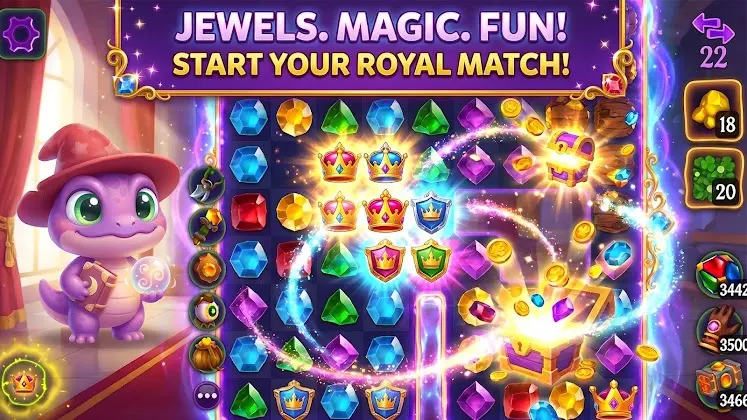
Royal Jewel Match, by Moko Jonh
Open the listing on Google Play
Price, taxes and any fees are shown on Google Play at the next step. Listings change without notice; the date above records only when these labels were last read from here.


Write to us
[email protected]Email is the only contact channel on this site. No forms, no newsletter and no data collection anywhere — you write, and the reply goes to the address you wrote from and nowhere else.